



















Integrated guest-experience platform
Ritz-Carlton Riyadh
We developed a guest-experience platform for the Ritz-Carlton Riyadh: bilingual booking, room services and AWS analytics, tied to the brand site.
- Year
- 2023
- Role
- Full-stack development: front end, back-end services and AWS
- Category
- Integrated guest-experience platform
The challenge
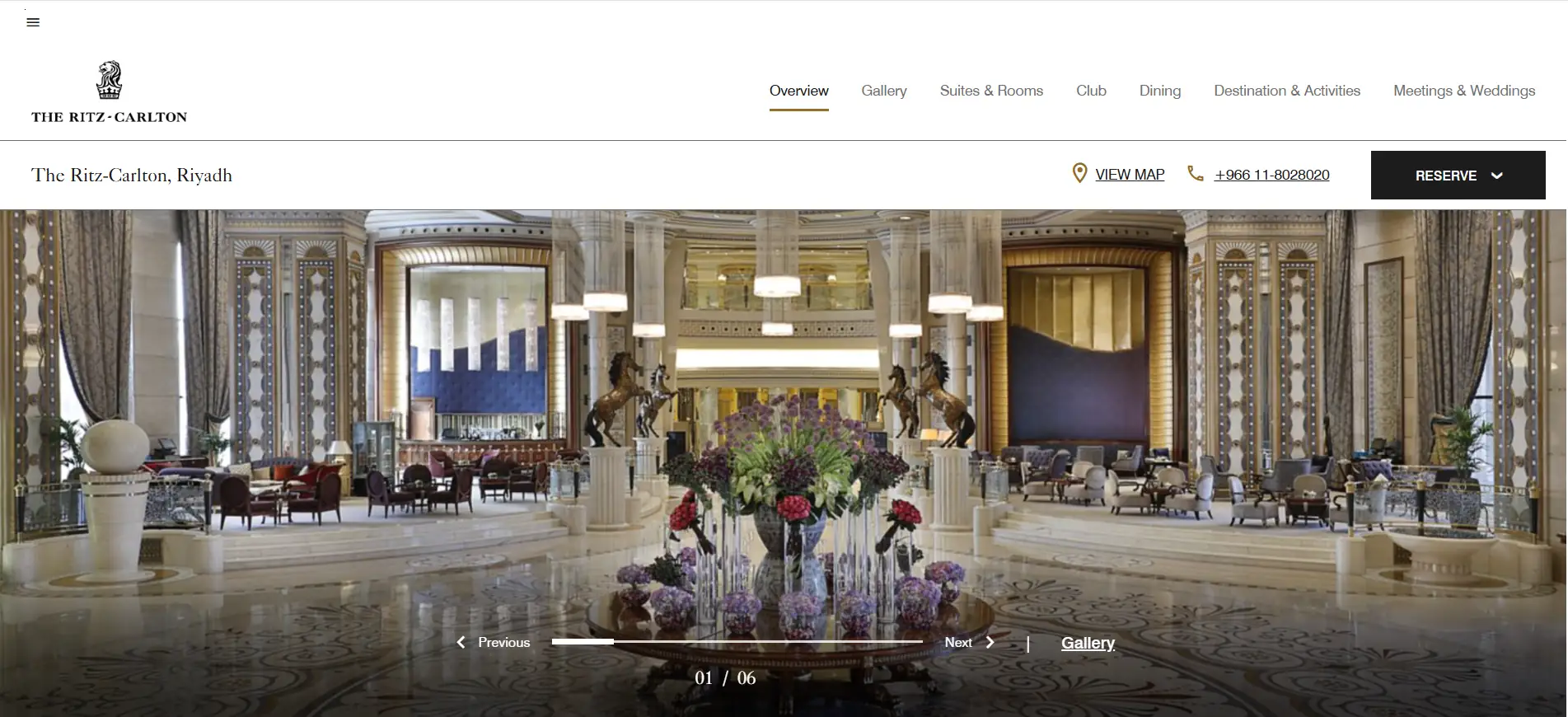
A luxury-hospitality property needed a guest-experience platform that sits beside the brand corporate site without breaking its conventions: a bilingual booking flow, in-room services and an analytics layer the operations team can read in the morning.
The approach
A Next.js front end for the booking and content pages, Node.js services behind it for room state and guest history, PostgreSQL as the source of truth, and AWS for the parts that must not go down. Native right-to-left Arabic typography with Arabic copy that was written, not machine-translated.
The outcome
The platform was delivered on the Ritz-Carlton Riyadh project timeline, with analytics dashboards for the management team. The brand corporate site itself was outside the scope of this work.
Under the hood
- Field
- Luxury Hospitality · Marriott property
- Type
- Guest-experience platform + bilingual booking + ops analytics
- Team
- Full-stack engineering (us) + brand designer + operations stakeholder
01
The real problem
Luxury hospitality is not e-commerce. A guest paying for a luxury stay will not forgive a 700ms button delay, an Arabic word broken across the wrong line, or a checkout that shows the wrong currency for two seconds. The brand site has decades of conventions (typography, animation budget, photography treatment) that any property-level extension must respect without copying them poorly. The brief: build a property-specific guest layer that feels like Ritz-Carlton, not like a SaaS plugin on top of Ritz-Carlton.
02
Who did what
Full-stack engineering ownership — Ali Yosef Software built the React/Next.js front end, the Node services, the Postgres schema, and the AWS deployment. Worked alongside a Marriott brand designer (who owned visual identity) and the property's operations stakeholder (who owned business rules). We did not own the corporate brand site itself; the integration boundary is documented in the contract.
- Front-end engineer
- Next.js 13, App Router, RSC for the public surfaces, bilingual ar/en with RTL-first typography in both Latin and Arabic faces. Hit luxury-grade animation budgets (no jank on iPad in-room devices).
- Back-end engineer
- Node.js (Fastify) + Postgres schema for room state, guest history, in-room service requests. Snapshotted PMS feed via scheduled job.
- DevOps + AWS
- CloudFront CDN, S3 for static assets, RDS Postgres, CloudWatch alarms tied to PagerDuty. Multi-AZ for the ops API. Daily snapshots, restore-tested.
- Arabic-first localisation
- Native Arabic UX copy + RTL design pass on every screen. No machine translation; reviewed against Marriott brand voice in Arabic.
03
Architecture
01 — Edge
Edge tier
CloudFront
AWS CDN
Global edge cache; KSA + Bahrain + UAE edges hit on most guest sessions
Route 53
DNS · weighted
Geo-routing for the bilingual landing experience
02 — App
Application tier
Next.js 13
App Router · RSC · SSR
Public booking + in-room surfaces
Fastify API
Node 20 · TypeScript
Room state, guest history, in-room service requests
PMS sync worker
BullMQ · 5min schedule
Snapshots PMS feed into Postgres; never writes back
03 — Data
Data tier
RDS Postgres
Multi-AZ · daily snapshots
Source of truth for guest history + service requests
S3
Static assets + uploads
Photography assets + signed URLs for in-room service receipts
Redis (ElastiCache)
Session + room-state cache
refreshed by sync worker
04 — Observability
Observability + alerting
CloudWatch
Metrics + logs + alarms
Booking-API p99, error rate, PMS sync freshness
PagerDuty
On-call rotation
Critical alarms route to property tech + us as fallback
04
Challenges
- 01
Brand integration without brand pollution: property pages must share the corporate header/footer without inheriting any custom CSS that would later drift when corporate updates.
- 02
RTL parity: every layout, every animation, every gradient direction tested in Arabic. Luxury Arabic typography requires custom kerning + line-height tuning that defaults from Tailwind cannot deliver.
- 03
In-room iPad surfaces: ageing devices, cracked screens, sticky touch — UI must remain usable at 30fps on 5-year-old iPads in real housekeeping conditions.
- 04
PMS (Property Management System) integration without becoming a PMS clone: read-mostly, snapshot-based, never the source of truth for reservation state.
- 05
Operations dashboard the GM actually reads at 6am — printable, glanceable, no chart that requires hover-interaction.
05
Hard problems
Two CSS reset systems coexisting
Corporate site ships its own normalize. Property extension must isolate via shadow-DOM-style scoping (CSS Modules + a strict prefix) so corporate updates never break property pages and vice-versa.
Arabic numeric tabular alignment
Booking flow shows prices + dates + room counts in dense tables. Arabic-Indic digits render at different widths than Latin in some font families — settled on `font-feature-settings: "tnum"` plus Hindi-Arabic fallback chain.
PMS snapshot consistency
PMS feed updates every 5 minutes; UI must reflect "last refreshed 3m ago" honestly without showing stale-data UI as confident. Built a freshness pill on every room-availability call.
06
Why these technologies
Next.js 13 (front end)
- i18n routing with locale subpath (/ar, /en) is first-class — no third-party translation framework.
- Server actions handle form submissions without the API round-trip JavaScript would normally require.
Postgres + RDS Multi-AZ
- JSONB columns store the wildly variable PMS payloads without a migration per upstream field change.
AWS over GCP/Azure
- Marriott IT already speaks AWS — Route 53 zones, IAM federation, billing consolidation all pre-existed.
07
What we learned
- 01
Luxury is consistency, not flash. Every animation budget exists to make the guest forget software is present.
- 02
PMS integrations are read-mostly. Never become a second source of truth for reservations; you will lose every reconciliation argument with the front desk.
- 03
RTL is not a configuration flag — it is a design discipline you apply at every layout decision, every animation curve, every gradient direction.
Stack
- Next.js
- Node.js
- PostgreSQL
- AWS S3 and CloudFront
- AWS RDS
- CloudWatch
Questions about Ritz-Carlton Riyadh
Who built Ritz-Carlton Riyadh?
Ritz-Carlton Riyadh was built by Ali Yosef Software, a software company in Damascus. Our scope on the project: Full-stack development: front end, back-end services and AWS.
What is Ritz-Carlton Riyadh?
We developed a guest-experience platform for the Ritz-Carlton Riyadh: bilingual booking, room services and AWS analytics, tied to the brand site.
What technology does Ritz-Carlton Riyadh use?
Next.js, Node.js, PostgreSQL, AWS S3 and CloudFront, AWS RDS, CloudWatch.
When was Ritz-Carlton Riyadh built?
It was built during 2023.
Can you build a system like Ritz-Carlton Riyadh for my business?
Yes. We build ERP systems, point-of-sale systems, mobile apps and websites for clients in Syria, the neighbouring countries and the Gulf. Contact: info@aliyosef.online.